
 Continue with Google
 Continue with Yahoo
Small-cap Funds
Small-cap mutual funds are a category of equity mutual funds that invest at least 65% of their assets in small-cap companies—those ranked 251st and beyond in terms of market capitalisation, as per SEBI (Securities and Exchange Board of India) classification. These companies are typically in the early stages of their business cycle and have significant room for growth, though they are also more volatile and risk-prone compared to large-cap and mid-cap firms.

How Small-Cap Funds Work
Small-cap equity funds focus on investing in equity or equity-related instruments of small-sized businesses. Their primary goal is to achieve long-term capital appreciation. Due to their smaller size, these companies can expand more aggressively, and the mutual funds that invest in them aim to capture this growth potential. However, with limited operating history and resources, these companies may be more vulnerable to market downturns or economic uncertainties.
Features and Advantages

Another advantage is portfolio diversification. Small-cap funds expose investors to sectors or businesses that might not be present in large or mid-cap funds, offering a broader mix of opportunities. These funds also provide access to undiscovered opportunities, as many small-cap firms are under-researched or undervalued due to limited analyst coverage.

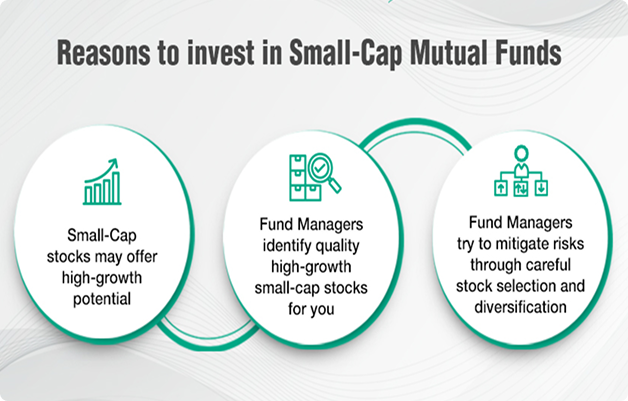
One of the main attractions of small-cap funds is their high growth potential. Since they invest in emerging businesses, there’s a chance to gain substantial returns if the companies succeed and grow into mid or large-cap firms over time.
Who Should Invest
Small-cap funds are best suited for:
- ✓ Investors with a high-risk appetite, as these funds are more volatile.
- ✓ Long-term investors with financial goals like retirement or children’s education, where the investment horizon is ideally over 5–7 years.
- ✓ Value-seeking investors looking to invest in future mid-cap or large-cap companies while they are still in the early stages and available at lower valuations.


Points to Consider Before Investing
While the returns can be attractive, small-cap funds come with several risks
- ✓ They are highly volatile and react quickly to market changes.
- ✓ Short-term investments (less than 3–5 years) may not be sufficient to offset market fluctuations.
- ✓ Not every small-cap company succeeds. Some may fail due to weak business models, poor management, or inability to cope with market challenges.
How to Invest
Investing in small-cap mutual funds is simple once compliance is done. You can invest directly through fund house websites or via mutual fund distributors. Investment modes include lump sum and Systematic Investment Plans (SIPs).


Conclusion
Small-cap mutual funds offer an exciting opportunity for long-term investors willing to accept higher risk for potentially higher rewards. With proper due diligence and a long-term horizon, they can play a valuable role in wealth creation